Saturday, 20 November 2010

FIONA'S LAST OPERATION


Fiona McLaughlin
had surgery in the hospital of Can Ruti on Wednesday October 13, 2010. I got up at six, showered, and drove to Badalona, because it was scheduled that at eight in the morning they would take Fiona to the operating room. The day was awful. Pouring rain and strong gusts of wind accompanied it.

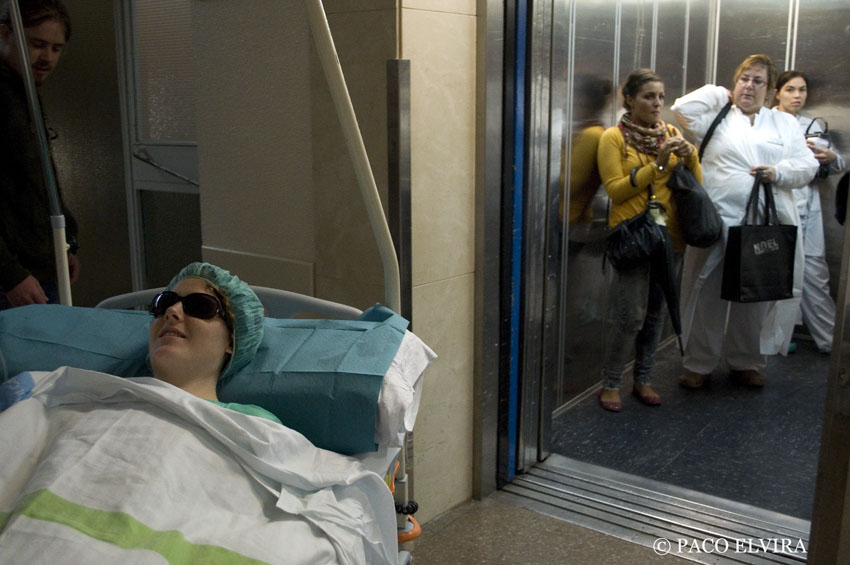
I found Fiona’s room quite easily. There was Marie-Pierre, her mother, who had spent the night with her. My surprise was that the room was in darkness and Fiona wearing sunglasses. The reason was that they had given her a very innovative product, but it affected the eyes that were to be protected from light. I joked telling her that she seemed a known actress prepared for an aesthetic operation.

I took some photos at half second and at an f: 4 opening with an ISO of 3,200, taking advantage of the half-open door. Then, a nurse closed it and we were in total darkness. Marie Pierre began to review the messages on her cell phone wishing the best for Fiona and I used the light to make her a portrait. F: 4 ... and 4 seconds hand held. No wonder that the photo is blurred, in spite of the stabilizer.


At eight o'clock they came for Fiona who never stopped smiling. She was the calmest of us all. Her family and I said goodbye to her at the door of the theater. They didn’t give me permission to photograph the operation, which was not my intention. Of course, a picture just before would not have been wrong.


FIONA'S FAMILY

Brian, the father of Fiona and Marie-Pierre told me that the operation would be very long, as usual. I was advised to go home and be warned when they told them that lacked an hour to finish, more or less. They, with long experience, had brought their laptops and would be working in the library.

I returned home after suffering a monumental traffic jam .It took an hour to get home. Damn traffic!
I worked and ate. Still had no news and was very nervous. I decided to take the car and return to the hospital. Fiona's parents there, confirmed that everything was going fine and that the operation would end at about five in the afternoon. They had started at nine o'clock. Eight hours of action!

Shortly after the five, surgeon Cristina Hostalot attended us just outside the operating room doors. Everything had gone well although at first there were complicated by a hemorrhage. Fiona was asleep in the reanimation unit that day led by Dr. Marta Hinojosa. We were able to enter, one by one, with the robe of rigor and see Fiona that was unconscious. We were told that due to the hardness of the operation Fiona may remain sedated until eight o'clock in the morning of the next day, all depending on her vital signs. The doctor recommended us to go home. She would warn us of any developments. We could come back after ten at night when it was allowed, one by one, family visits in the reanimation unit. After the jam I had suffered in the morning between my home in Barcelona and Badalona, I did not want to repeat it. Marie-Pierre kindly offered me to drive to her home in Teià, a journey with much less traffic, eat something and then returning after ten at night.


FIONA'S FAMILY WITH DOCTOR MARTA HINOJOSA


It was over an hour since the end of the operation and from the car we could see the sea. I suddenly discovered a rainbow appearing. Coincidences, strange things, mysteries of the mind, but I had the deep feeling that everything had gone well and that Fiona was all right. Then Marie-Pierre's cell phone rang. It was Doctor Marta Hinojosa, the head of the reanimation unit, to say that Fiona was awake, fresh as a daisy, and that she had asked for her family, surprised that no one was there.

What a girl! After a very complicated operation of 8 hours, including bleeding, nothing about sedate and let her sleeping overnight. An hour and thanks. Incredible!

I saw Fiona about 10.30 pm on the reanimation unit and took the photo of a happy ending. I said goodbye to her and her family and returned to Barcelona.


Fiona McLaughlin
remained in hospital until after the weekend and Tuesday returned home.

(TO BE CONTINUED)

Friday, 19 November 2010

AN UNEXPECTED ENCOUNTER

PHOTO: FIONA MCLAUGHLIN

I met Fiona again. It had past almost a year since I saw her in early summer. I went with a friend to the cheese shop, La Seu, in the Ciutat Vella of Barcelona whose owner is Scottish, when I seemed to recognize Fiona serving a table. Is Fiona I asked the owner? She was. She’s the niece of the owner of the premises and she used to come to help her every Saturday morning. We were delighted to meet each other and since then I came back a few more times during the summer.


KATHERINE. PHOTO: FIONA MCLAUGHLIN

The news that Fiona gave me were not good. The tumor had returned, keep growing and they did not dare to operate her. The possibility of terrible side effects was too high: half-body paralysis, speech loss, blindness ...

In late summer, Fiona was on holiday in France with her mother and suffered a hemorrhage. They translate her by ambulance to the hospital of Can Ruti in Badalona, where she spent a few days very tricky until they allowed her to return home. "This time I thought I wouldn’t make it" she told me later.

Should be in late September when she phoned me. "I have good news," Fiona said explaining that her surgeon, Dr. Cristina Hostalot, a young doctor just over 30 years, that had operated her in the 4 previous occasions would do it again. "I’d like that this time you do me the photos," said Fiona.
I must admit I was flattered, but at the same time very worried. I knew it was a very complicated operation. What if something went wrong?

In addition there had been an unusual occurrence. Just the day after the operation scheduled for Fiona, Claudia Maccioni, who had just overcome breast cancer and had been taking photographs of herself, had invited me to the presentation of her book: "Claudia, a year of my life." It contained "a signal beyond my reach” that this would occur just the following day after Fiona’s operation?

The day of surgery approached and I was getting more nervous and worried.

(CONTINUATION)

Tuesday, 16 November 2010

MY PHOTO JOURNAL IN THE HOSPITAL

FIONA'S FAMILLY FOLLOWING HER ON THE STRETCHER TO THE OPERATING THEATER


When they told me that they had to operate on me again, I realised that it would be difficult to continue with the end of course project on the Carrer Montcada. And walking along the hospital corridors of Can Ruti, the subject of my project jumped out right in front of my eyes. Can Ruti, my dear Can Ruti, my blue pyjamas, the corridors, the needles, the pills, the nurses, and the hours of waiting. To capture this moment of my life was very important.


We humans are such cowards that at the first blow we retreat. Listening to the comments around me, it seems that people don’t feel like fighting for life and they don’t know how to appreciate the happiness which is offered to them. It’s not about asking yourself if you are the lucky one who is going to be happy but to look in the right direction, and to do it with patience and confidence.


The world is so big, and it is full of stories like mine. The person who has lost a member of the family, a friend, a child. The one who had a car accident. The one who misses the woman who has left him. The one who is blind....

I have been living with my illness for five years and I really want to explain to you the lessons I have learned, how my way of looking at life has changed. Above all in this last year. I feel I want to live life completely. I look at things day to day with peace and tranquillity and everything is easier for me.The day to day is what we have.Life is a continual battle, never stop. You have the right to get angry at the world for a day or two, but don’t stop being positive. It is simple. It is gratifying.


Live in peace and tranquillity, first of all with yourself and after with the rest. Unfortunately, everyone goes so fast in the street and in their life that they don’t even think about dedicating some time to themselves.

Meditate and reflect. Listen to a song, or two..... Read a chapter of a book. Have a bath. Give yourself a present every day. Listen to yourself.


PHOTO: MARIE-PIERRE DURAND


Life is shit! Of course more than once I have rebelled against life. So many hours in the hospital, so much uncertainty, so much wasted time. Sometimes I have thought that it would be easier to die. I have all the right in the world to complain, when I do complain. However, deep inside me, I think that this reaction is acceptable, if it is a passing one. It is important that it doesn’t get lodged in you. It is necessary to expel the rage so that you can then feel relaxed and once more hold fast to the happy and positive life you have wanted to have.


A last bit of advice.
If you are lucky enough to have people around you who love you and are concerned about you, don’t be so proud and ask them for help. Let them spoil you. This will give you happiness and strength.

I have always been a proud and stubborn person and I have pretended that I was able to get out of this on my own. You should see the problems I have solved myself, but there is absolutely no way I would have come out of this, nor do I know if I would still be here if it were not for my family, for my friends and people who know me.
Friendship united with love is so necessary, it generates so much energy. I know very well that many people love me. Not a day goes by without me receiving positive energy from someone.
Many people tell me that I am the one who sends you positive energy, but that’s not completely true. You give, I receive. I give, you receive. We are united. Life is an exchange.


Now I really want to say to you: Your love is my hope. The love I feel for you is infinite. Your smile is my smile. Thanks to you all I have become stronger. You have made me believe I am capable of everything and more if I propose it to myself.


Image and video hosting by TinyPic


Love all of you!
Life is a continual battle.
Never stop, no matter how tired you are.
Don’t lose hope, however fed up you are.
The world is full of problems and yes, life is hard.
Do not lose hope, you are strong, you know you are.
It would be a pity to stop halfway along the road.
Keep fighting.
One day I know we will get there, we will do it.
Life is beautiful.


Text and photos: Fiona McLaughlin


(TO BE CONTINUED)

Friday, 12 November 2010

RECEIPT OF MONKFISH WIHT BURNT GARLIC AND FIONA McLAUGHLIN


Fiona's story is the kind that puts a lump in your throat and settles in your heart forever. Fiona McLaughlin is a 23 years old Catalan woman, of a Scottish father and French mother. Although, Irish blood run through her veins because his father's family was originally from County Donegal. Fiona speaks four languages without an accent, well, the Spanish with a noticiable Catalan accent.

By her courage and her looks it would cost me nothing to image her as one of those heroines of Irish blood who conquered the Wild West in the films of John Ford. Or for his mastery of languages and bravery, as Catherine Pradier, the English-French protagonist of the novel by Larry Collins, Fall from grace, parachuted into occupied France to confuse the Nazis about the true location of the invasion. Or as Linda Voon, an American Jewish spy in Nazi Germany, played by Melanie Griffith in the Shining through movie.

Fiona was diagnosed with a brain tumor at age 18. Since then, they have operated her on five occasions. In the penultimate, she told her story through photos, a joint project with her friend Oliveira Thais, both students of Quim Roser and mine in the photojournalism course we lecture at IDEP, another case like Claudia Maccioni, photography as a therapy. I offered my blog to do so. I went to see her in El Masnou to plan the story and then invited, she and her mother Marie Pierre, to try a tasty tradicional Catalan fishermen dish, Rap al all cremat (monkfish with toast garlic) to talk about the final details . Tomorrow you can learn about the history of Fiona McLaughlin.

Let’s go to the recipe.

RAP AL ALL CREMAT (MONKFISH WITH BURNT GARLIC)

Ingredients for four people.


1 kg of sliced monkfish.

1 kg of potatoes.
200 gr. ripe tomato, peeled, chopped and seeded.

1 liter of fish stock or, alternatively, fish broth in carton or a tablet of fish broth dissolved in 1 liter of water.

Parsley 4 garlic 10 toasted almonds.
1 slice of bread from the day before.

1 chili.

Salt and pepper.

Virgin olive oil.


Preparation.


Peel the tomatoes, cut it clean, leaving out the seeds, rather small. Peel the potatoes and break into pieces with a knife, so they’ll release the starch. Peel the garlic and cut in half.
In an earthenware pot or cast iron fry the garlic until golden.Reserve. In the same oil fry the slice of bread and reserve. Put then the diced tomatoes and cook at a very low heat until they becomes a jelly. Put the potatoes, cover with fish stock and add the chilli. While the potatoes are half done prepare the paste in a mortar. The carlic,the fried bread, two tablespoons of parsley and the almonds. When the potatoes are half done, put the monkfish slices, that will have salted previoously. Then left 15 minutes or so and add the paste that we’ll have dissolved in a little broth.

I had prepared rap a l'all cremat in the past, but this, as I think my guests will testify, was really good. I think because of the fish stock and the paste. In other ocassions I haven’t used them.


Fiona and Marie Pierre brought a white wine from her area, a Marques de Alella Pansa Blanca, made with a grape variety named Xarel.lo who combined beautifully.


Fiona will show you her photos and her story tomorrow.

Tuesday, 28 September 2010

WALKING IN BERGAMO’S CITTÀ ALTA.


Although I had been before photographing other cities in the area, such as Milan, Turin, Brescia and Verona, I had never been to Bergamo. Work in L'Eco di Bergamo let us not spare time to my Cases’ fellows, Javier Rodriguez, Enzo Iaccheo and me. We would go to the Newspaper before ten-thirty, spent half-hour break for lunch, and ended our work on nine in the evening, after completing the first meeting to decide on the cover.


Image and video hosting by TinyPic


Many people had told me about the beauty of the Città Alta in Bergamo. Enzo and Javier had already visited it. The days were beautiful and sunny, so I told people in the newspaper that the next day I would visit the Città Alta, first thing in the morning, from eight to ten. I was very lucky that after hearing that, Mauro Albonico, production manager of the newspaper group and a passionated for photography offered to accompany me in his car. The next day we walked, both of us, taking pictures and enjoying the beauty, so common to many Italian cities. Mauro took me some great pictures and got the permission to photograph the Piazza Vecchia from the windows of the Municipal Library.


FOTO: MAURO ALBONICO


The pictures I took with my digital camera do not differ in anything with the ones I use to take before with analogic cameras and slide film. But the picture I made inside the Basilica of Santa Maria Maggiore was entirely different. To achieve a similar result, I would have shoot using a tripod, at a slow speed, so I should have asked permission. In addition, to prevent the fall of lines should have used an expensive PC lens (Perspective Control), also known as shift lens. With digital technology, I just made a single shot, with an ISO of 200 ASA, hand held, using a speed of 1 / 8 of a second without getting a blurred image thanks to the 18-55 mm zoom with stabilizer (VR). After, I straightened the lines using the lens correction tool in Photoshop. Here you can see the picture as I took it. You have to trim it a little, but it was worth it.


Image and video hosting by TinyPic


FOTO: MAURO ALBONICO

Monday, 27 September 2010

PHOTO EDITOR AT THE ITALIAN DAILY L’ECO DI BERGAMO

ENZO IACCHEO & JAVIER RODRÍGUEZ TEACHING THE ITALIAN JOURNALISTS


Yes, I know that seems strange, But I'll explain it to you. It’s been a job for Cases i Associats. Casas is a world famous Catalan company, named after its founder and creator Toni Casas, and that is mainly engaged in newspaper design.
And it does all over the world. To date, more than one hundred and fifty newspapers, some Spanish as El Periódico de Catalunya, AND, Public or Avui. Among foreigners, many South American, British, French, Russian, Irish, Belgian, Dutch, Croats, Poles, Italians, and even in Nigeria, Ukraine and Latvia.

The study was remodeling l'Eco di Bergamo, the journal of the beautiful Italian northern city, near Milan.


Image and video hosting by TinyPic


The newspaper renovation was beeing done by two reputated designers, the project director, Enzo Iaccheo, Italian, and art director Javier Rodriguez, a Venezuelan who lives in Barcelona. Both observed an evident lack of quality in the newspaper’s pictures and thought of me to accompany them for a week, give a lecture to the entire newspaper staff explaining, with examples, the qualities needed for commissioned and published photos. I designed a program tailored to the daily, which of course had many of the concepts and examples I taught at the University, and also many photos taken by me in Italy.


JAVIER RODRÍGUEZ & ENZO IACCHEO


The main problem I detected was the lack of a chief photographer or editor. The newspaper has a network of freelance photographers. The asignements arrive to them, usually, by phone without any further information. Photographers send their pictures online to the journal and there, the journalist chose the photos and inserted them into pages where the spaces for the photos to fit in are, most of the time, of formats other than the original photos, often square.


WITH TWO OF THE NEWSPAPER'S PHOTOGRAPHERS. FOTO: BEPPE BEDOLIS


During the days in Bergamo, I met with photographers and art director, Carlos Steiner, exercising, sometimes the role of picture editor, but of course he could not cope with all the work. In the afternoon, I controlled the photo elections and the page layout exerting a didactic work. At night, I attended the meeting to make the cover and provided my opinion on the choice of the pictures and the best frame.


AT LUNCH WITH THE DAILY DIRECTORS


RESTAURANT L'OSTERIA DI VALENTI


L'ECO DI BERGAMO


MEETING FOR MAKING THE COVER. WEARING THE YELLOW SHIRT, DIRECTOR ETTORE ONGIS


Meanwhile, Javier and Enzo taught courses, morning and afternoon, to the newspaper reporters. In my view, the main problem was not the photographers but the poor editing of their photos. Here you can see one of the newspapers in which I participated and where you can see a display of more modern images, like the train and the blurred pedestrians, and photos more dynamic like the fire and the firemen.


Communication was quite fluid regardless of language. Every time I had been to Italy before, all the movies in original version of Fellini, Pasolini, Visconti and Bertolucci I saw, the songs of Adriano Celentano, Ornella Vanonni, Domenico Modugno, or Mina I lissened to, and the book I studied during the holidays helped in a very positive way.


THANKS TO THE NOTEBOOK I COULD KEEP ON DAILY WITH THE BLOG ENTRIES, BACK AT MY HOTEL

Monday, 30 August 2010

VISA POUR L’IMAGE: 22 FESTIVAL OF PHOTOJOURNALISM IN PERPIGNAN


It arrived, as every year, the unmissable event for lovers of photography: the most important festival of photojournalism in Europe, Visa pour l'Image 2010, that we Catalans have the luxury of having only at two hours drive from Barcelona.

The professional week will run from 30 August to 5 September. Since Sunday there were people getting credited in the Palau Pams.


PALAU PAMS


This year's edition is back in force, improving on the previous year. I would highlight three areas:

The photo of daily events that has strong impacts on violence and injustice that are shaking the planet. It is ,and has always been, the primary role of photojournalism and, with the unprecedented force that has the unique image, we must continue to raise our commitment to such inequality and injustice. As expected, the earthquake in Haiti and the revolt in Thailand bear the palm.

In the World Press Photo , also present here and that the locals from Barcelona will soon enjoy thanks to Photographic Social Vision, there are images that border on the insufferable as the stoning of a man. Are these images that show a death in live ,and that are so awful, should be shown? Just remember about Sakineh Mohammadi Astiani in Iraq ordered to be stoned for adultery. Images of the World Press do not allow us to fall into indifference and makes to add all our forces to prevent such a great barbarity.


Image and video hosting by TinyPic

WORLD PRESS PHOTO. COUVENT DES MINIMES


Other blocks are the retrospectives exhibitions. Two of them superb. Worth to attend Visa pour l'Image 2010 only to see them.


William Klein
: New York, Rome, Moscow, Tokyo.

Klein, along with Robert Frank, is the greatest living photographer. His book New York broke with everything that had been in documentary photography before. Today, his pictures have not lost a shred of modernity. They are still great images for this time.


Image and video hosting by TinyPic

WILLIAM KLEIN EXHIBITION IN LE COUVENT DES MINIMES


William Albert Allard. National Geographic. Five Decades: A Retrospective.

Allard is one of the masters in colour and one of the best National Geographic Magazine’s photographers. I would like to highlight certain phrases in his introductory text to the expo:

"Many of the photographs in this exhibition were made while in the road, in a bar, in the streets, or even walking in the countryside. Often not looking for anything in particular. I used to be receptive to what the chance would like to bring. I just watched".

"When I give a talk to young people I explain that, when they leave to find work (as do virtually everybody must do if they want to have a car or enjoy a home with amenities) think about finding an activity you enjoy doing with all your heart rather than thinking about the money. Not many people can say that. I'll can say it without problem. I know what it is to work all life on a task that fascinates me".


WILLIAM ALBERT ALARD EXHIBITION. COUVENT DES MINIMES

WILLIAM ALBERT ALARD EXHIBITION. COUVENT DES MINIMES


The third block is formed by stories in -depth. I think a great part of the future of photojournalism goes through here. I would highlight:

Polygamy in the U.S.
by Stephanie Sinclair of Seven for National Geographic and The New York Times

An intimate look on one of the most closed Mormon sect known for its practice of polygamy.

One wonders, how the hell some photographers get access to these issues?


The Urban Cave
by Andrea Star Reese.

For two years this American photographed the lives of these homeless, men and women, living in New York, showing then with great dignity. Under a bridge, in a dilapidated building or in a tunnel, these photographs reveal the beauty of a place and a people.


THE URBAN CAVE. COUVENT DES MINIMES


Eloi the bubble child
by Hubert Fanthomme.

Another in-depth report of the history of this baby and her mother ,who can only embrace and comfort him through the plastic.


The black gold in Chernobyl
by Guillaume Herbaut

Twenty years after the catastrophe, the military machine cemeteries and the Chernobyl plant in Ukraine are subject to a full-scale looting.
Great example of work and investigative reporting.


Ian Fisher, an American soldier
by Craig F. Walker.

The story followed over two years and a half, this young American soldier since he joined the army, his training, his stay in Iraq and their return home.


Migrants in Calais
by Carsten Snejbjerg.

This story was named a 2010 Humanitarian Care award.

In the Arsenal des Carmes are presented some of the best images of the international and French press. You can see Albert Bertran’s Haiti photos done for el Periodico de Catalunya, and there’s also the Diari de Terrassa represented by photographer Cristobal Castro.


DAILY PRESS. ARSENAL DES CARMES


And finally, a visit to l'Eglise des Domicains where, among others, is the exhibition of National Geographic photographer specializing in nature, Mike Nichols, The sequoias: the war of timber in California. Stresses a giant 18-meter,colour print, sponsored by Canon, one of the photos of Nichols that stands in the impressive frame of the Church.


Image and video hosting by TinyPic

MIKE NICHOLS' PHOTO. EGLISE DES DOMINICAINS