Monday, 30 August 2010

VISA POUR L’IMAGE: 22 FESTIVAL OF PHOTOJOURNALISM IN PERPIGNAN


It arrived, as every year, the unmissable event for lovers of photography: the most important festival of photojournalism in Europe, Visa pour l'Image 2010, that we Catalans have the luxury of having only at two hours drive from Barcelona.

The professional week will run from 30 August to 5 September. Since Sunday there were people getting credited in the Palau Pams.


PALAU PAMS


This year's edition is back in force, improving on the previous year. I would highlight three areas:

The photo of daily events that has strong impacts on violence and injustice that are shaking the planet. It is ,and has always been, the primary role of photojournalism and, with the unprecedented force that has the unique image, we must continue to raise our commitment to such inequality and injustice. As expected, the earthquake in Haiti and the revolt in Thailand bear the palm.

In the World Press Photo , also present here and that the locals from Barcelona will soon enjoy thanks to Photographic Social Vision, there are images that border on the insufferable as the stoning of a man. Are these images that show a death in live ,and that are so awful, should be shown? Just remember about Sakineh Mohammadi Astiani in Iraq ordered to be stoned for adultery. Images of the World Press do not allow us to fall into indifference and makes to add all our forces to prevent such a great barbarity.


Image and video hosting by TinyPic

WORLD PRESS PHOTO. COUVENT DES MINIMES


Other blocks are the retrospectives exhibitions. Two of them superb. Worth to attend Visa pour l'Image 2010 only to see them.


William Klein
: New York, Rome, Moscow, Tokyo.

Klein, along with Robert Frank, is the greatest living photographer. His book New York broke with everything that had been in documentary photography before. Today, his pictures have not lost a shred of modernity. They are still great images for this time.


Image and video hosting by TinyPic

WILLIAM KLEIN EXHIBITION IN LE COUVENT DES MINIMES


William Albert Allard. National Geographic. Five Decades: A Retrospective.

Allard is one of the masters in colour and one of the best National Geographic Magazine’s photographers. I would like to highlight certain phrases in his introductory text to the expo:

"Many of the photographs in this exhibition were made while in the road, in a bar, in the streets, or even walking in the countryside. Often not looking for anything in particular. I used to be receptive to what the chance would like to bring. I just watched".

"When I give a talk to young people I explain that, when they leave to find work (as do virtually everybody must do if they want to have a car or enjoy a home with amenities) think about finding an activity you enjoy doing with all your heart rather than thinking about the money. Not many people can say that. I'll can say it without problem. I know what it is to work all life on a task that fascinates me".


WILLIAM ALBERT ALARD EXHIBITION. COUVENT DES MINIMES

WILLIAM ALBERT ALARD EXHIBITION. COUVENT DES MINIMES


The third block is formed by stories in -depth. I think a great part of the future of photojournalism goes through here. I would highlight:

Polygamy in the U.S.
by Stephanie Sinclair of Seven for National Geographic and The New York Times

An intimate look on one of the most closed Mormon sect known for its practice of polygamy.

One wonders, how the hell some photographers get access to these issues?


The Urban Cave
by Andrea Star Reese.

For two years this American photographed the lives of these homeless, men and women, living in New York, showing then with great dignity. Under a bridge, in a dilapidated building or in a tunnel, these photographs reveal the beauty of a place and a people.


THE URBAN CAVE. COUVENT DES MINIMES


Eloi the bubble child
by Hubert Fanthomme.

Another in-depth report of the history of this baby and her mother ,who can only embrace and comfort him through the plastic.


The black gold in Chernobyl
by Guillaume Herbaut

Twenty years after the catastrophe, the military machine cemeteries and the Chernobyl plant in Ukraine are subject to a full-scale looting.
Great example of work and investigative reporting.


Ian Fisher, an American soldier
by Craig F. Walker.

The story followed over two years and a half, this young American soldier since he joined the army, his training, his stay in Iraq and their return home.


Migrants in Calais
by Carsten Snejbjerg.

This story was named a 2010 Humanitarian Care award.

In the Arsenal des Carmes are presented some of the best images of the international and French press. You can see Albert Bertran’s Haiti photos done for el Periodico de Catalunya, and there’s also the Diari de Terrassa represented by photographer Cristobal Castro.


DAILY PRESS. ARSENAL DES CARMES


And finally, a visit to l'Eglise des Domicains where, among others, is the exhibition of National Geographic photographer specializing in nature, Mike Nichols, The sequoias: the war of timber in California. Stresses a giant 18-meter,colour print, sponsored by Canon, one of the photos of Nichols that stands in the impressive frame of the Church.


Image and video hosting by TinyPic

MIKE NICHOLS' PHOTO. EGLISE DES DOMINICAINS

Wednesday, 18 August 2010

HOLIDAYS IN PORRERA

Image and video hosting by TinyPic


Porrera is only a half hour drive from Mont-Roig, in a beautiful valley surrounded by vineyards, in the heart of the Priorat region, in Catalonia. It was a pleasure to see Isabel Vilà, another of the people that appeared in “Lives in calm” who does not regret at all having left the big city to live in the country. Her rural tourism house, Cal Porrera, is a marvel with unparalleled views.


Image and video hosting by TinyPic


Isabel has undertaken further reforms which I am sure will improve her business. Along with his partner Edu, have a small vegetable garden. One day I came up with Luismi, Victor and the former director of Geo, David Corral. Isabel showed us her garden and gave us a basket full of organic vegetables that were very good.

ISABEL VILÀ


That night, the four of us, we stayed for dinner at El Xiringuito, a restaurant that opens on summer nights and places its tables beside the stream. Prices are very reasonable and many of the dishes, spicy and exotic. For example, I had grilled goat cheese and Thai chicken as a second and, of course, we always drink red wine from Priorat.


Image and video hosting by TinyPic

FROM RIGHT TO LEFT: LUISMI, VÍCTOR, DAVID Y PACO

For this trip I carried my small Gitzo tripod that was very useful for self-portraits. You saw in a former post my adventures taking such photos. This time it was very simple.


I am delighted that Isabel kept in a prominent place the picture that I gave her on the harvest in Porrera. It was the picture that opened the story published in the Sunday issue of El Periodico de Catalunya, titled The Last Wine Harvest of the Century that I photographed in October 2000.

Among the wines highlights el Trosset de Porrera that produces Eduard, an excellent wine with all the virtues of Priorat with production limited to eight hundred bottles.


Porrera is a magical place where the stress and time stop.

Thursday, 5 August 2010

MICHELLE OBAMA AND THE ICE CREAM PARLOR “LOS ITALIANOS” IN GRANADA


CECILIA DE ROCCO


No. I haven’t got pictures of Michelle Obama in the ice cream parlour “Los Italianos” in Granada. But I've been there many times and have tasted the famous ice creams that are great and cheap. Of course, accustomed to Barcelona’s prices is not difficult to have that feeling.

I love Granada and I've been there many times. The last time was during the past summer when I met National Geographic photographer Tino Soriano. A few years ago I did a report on Granada travel to the Sunday edition of El Periódico and photographed the ice cream parlour owner, Cecilia Rocco.

But will you know what I do every time I go to Granada and I consider my highest priority? : Dining at a restaurant in Albaicín overlooking the Alhambra. I recommend it strongly to all Granada’s visitors.


Sunday, 1 August 2010

CAN YOU FIND SIMILARITUDES BETWEEN HOOLIGANS AND STUDENTS AT OXFORD AND CAMBRIDGE?


VILLAREAL

After publishing the post of the end of year celebrations at Oxford and Cambridge there were several comments comparing with the English in Lloret for parties of bottle, etc. Then I remembered that years ago the editor of La Vanguardia Magazine, Pepe Baeza, sent me to cover the European Cup match Villarreal-Manchester United. And I could not help, perhaps a bit biased, compare images. Well, after all we are in August and the theme, sun, beer ... comes like a glove.


Image and video hosting by TinyPic

OXFORD

Image and video hosting by TinyPic

VILLAREAL


VILLAREAL


VILLAREAL

Monday, 26 July 2010

OXFORD AND CAMBRIDGE. COLLEGES GRADUATION PARTIES.

Image and video hosting by TinyPic

CAMBRIDGE


A few years ago, around this time, Albert Cañagueral and I travelled to Oxford and Cambridge for el Periodico Sunday newspaper. Our proposal was to make a portrait of two of the world most famous universities taking advantage of the current clip of their graduation ceremonies at the end of the course. I had read and seen a story about running wild celebrations that were held within the Colleges. I knew that access would be practically impossible, but I thought Iwould be able to find something in the streets, as it was.

In Cambridge I learned when I was one of the parties and the next day at dawn I was ready with my camera in front of the college where I could capture these images.


CAMBRIDGE

In Oxford, about nine in the morning in one of the pubs in the centre I photographed some of the graduates who had not been going to bed yet. They have all the earmarks of having had a very good time. Don’t you think?


OXFORD

Image and video hosting by TinyPic

OXFORD

The idea of this post I came after learning that journalism students of one of the universities where I teach had too, one of these parties. And I heard with nothing to envy to those of Oxford and Cambridge.
For me it really is exciting to realize that all these young journalists, to whom I have tried to convey my passion for photography, won’t be anymore on the other side of the table, but will be my new colleagues in this difficult but exciting profession.


CAMBRIDGE

Thursday, 22 July 2010

PHOTO MEETING BARCELONA ’10 OJO DE PEZ


During the 15, 16 and July 17 Barcelona was placed again on the map of world photography thanks to International Photo Meeting organized by La Fábrica. That meeting was a big success. Let’s hope that initiative to become a classic and to be repeated year after year. I won’t write an exhaustive chronicle.

The portfolio review was conducted by many well known locals as Silvia Omedes, Jessica Murray, Rafa Badía or Fernando Peracho.


SILVIA OMEDES

Among those who came from abroad I would highlight Christian Caujolle, Vu agency founder and one of the most important theorists of photography in the world, and Robert Pledge, to whom I took the opportunity to say hello. Bob, for his friends, is a photographic legend alive. In the golden age of photojournalism, he founded Contact, the photo agency in 1976. An agency that distributes the work of photographers like Annie Leivobitz, and who employed mythical photographers as David Burnett, Frank Fournier or Alon Reininger, all World Press Photo winners and with photos included in the list of the 100 photos of the century. I worked closely with Frank and Alon in Madrid in 1982, covering the Spanish general elections won by Felipe Gonzalez. There, Alon Reininger gave me my first lesson about how to use portable flashes. Those interested will find here the story.


ROBERT PLEDGE


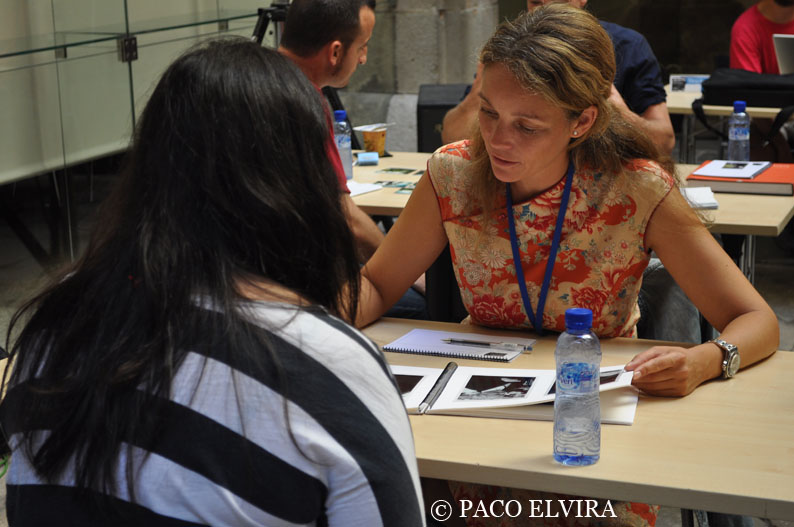
I attended to the Susan Meiselas’ and Oliviero Toscani’s conferences. I was particularly interested in the so-called “conversations with”. For half an hour, a dozen people could have a conversation with photographers as emblematic as Susan Meiselas and Alex Majoli of Magnum. We had to book in advance and I was lucky. I attended with David Monfil. Both are preparing a project with Nacho Rodriguez and the talks were very useful. Both Susan and Alex gave faith of the unstoppable interest in documentary photography, but recognized that the golden age of magazines were over. Both are experiencing with multimedia media images, in which they mix photos, video and sound. As already explained Pepe Baeza, the future of photography lays there.


I didn’t know well the work of Alex Majoli, an Italian who is one of the promising young Magnum photographers, but much better Susan Meiselas’, especially the photos she took in the Sandinista revolution in Nicaragua. La Fábrica had just released her book, but I already had bought it in London in 1981. I asked Susan, how no, to dedicate it to me. She saw the book and said. “Oh! It’s the old one!


FOTO: ORIANA ELIÇABE

Alex said something very important. He said you must take into account what the market needs. You can do a thorough job on your wife and then complain that you don’t get it published with all kinds of excuses, he said. Everybody wants to go to photograph Afghanistan to, but the media can only publish a couple of stories, not eighty. Instead the media is searching stories on the economy, on the crisis on Wall Street, etc. In short, if we want to get published we need to know what is being sought, not only photograph what interest us.


ALEX MAJOLI

Finally, although the lectures were the most interesting, we photographers always get distracted by small details that attract our attention.


PICTURES FROM MY WINDOW. ANOTHER HERRING GULL


They are called Larus Argentatus in Latin. It is the species of gull that has colonized Barcelona. They are big, aggressive and very beautiful. This is a very rare photo. I shot this kind of seagulls sometimes to the series from my window, but they very rarely drop below the tops of the trees on the Gran Via. This is one of them and I could catch the moment. Light is important, the causeway of the street is in shadow but sunlight gives full in the bird.